
Wholesale fruit prices in Morocco are influenced by seasonality, product variety, available supply, quality grade, size, order quantity, packaging, transport, destination-market requirements and commercial terms. A single price per kilogram cannot represent every fruit, supplier or export shipment.
For international importers and wholesale distributors, the most useful question is not simply “How much does Moroccan fruit cost?” but “What is the price for this exact variety, quality, net quantity, packing format and delivery basis?” This guide explains the factors that determine Moroccan fruit quotations and shows how to compare offers without relying on misleading price lists.
MoroccanProduce.com researches suitable Moroccan suppliers, purchases produce and resells it to international wholesale buyers under agreed commercial terms. We do not publish guaranteed stock or fixed wholesale prices, because actual offers depend on the requested goods and current sourcing conditions.
Why there is no single wholesale fruit price in Morocco
A fruit price at a Moroccan wholesale market, a quotation for packed goods at a Moroccan dispatch point and a delivered price at an overseas warehouse may describe very different commercial transactions. They can include different services, risks, packaging and transport costs.
Even two lots of the same fruit may differ in variety, maturity, grade, calibre, external condition and packing. A meaningful comparison must use the same product specification, quantity, currency and delivery basis.
This article does not invent current market prices or claim to provide a live price feed. Actual quotations must be requested and confirmed for the intended order.
1. Seasonality and harvest timing
The harvest calendar affects which fruit varieties and grades can be sourced. Supply may increase during an established harvest period, but price does not automatically decrease. Weather, demand, quality, export competition and packing costs can influence the final quotation.
| Seasonal situation | Possible effect on offers | Buyer action |
|---|---|---|
| Early harvest | Limited commercial quantities or calibres may be available. | Confirm maturity, grade and shipment date. |
| Main season | More sourcing options may be available, subject to demand. | Compare actual lots and packing formats. |
| Late season | Remaining varieties and quality can differ from peak supply. | Check condition, shelf-life needs and final availability. |
| Weather disruption | Reduced volumes or changing pack-out may affect quotations. | Reconfirm supply and validity before ordering. |
Use our Moroccan produce seasons guide for planning. Category-specific information is available in our Moroccan citrus season and avocado season articles. These resources do not guarantee live availability.
2. Fruit variety and commercial demand
Different varieties of the same fruit can have different harvest windows, customer preferences and quality characteristics. Buyers should name the preferred variety wherever possible.
Oranges and mandarins
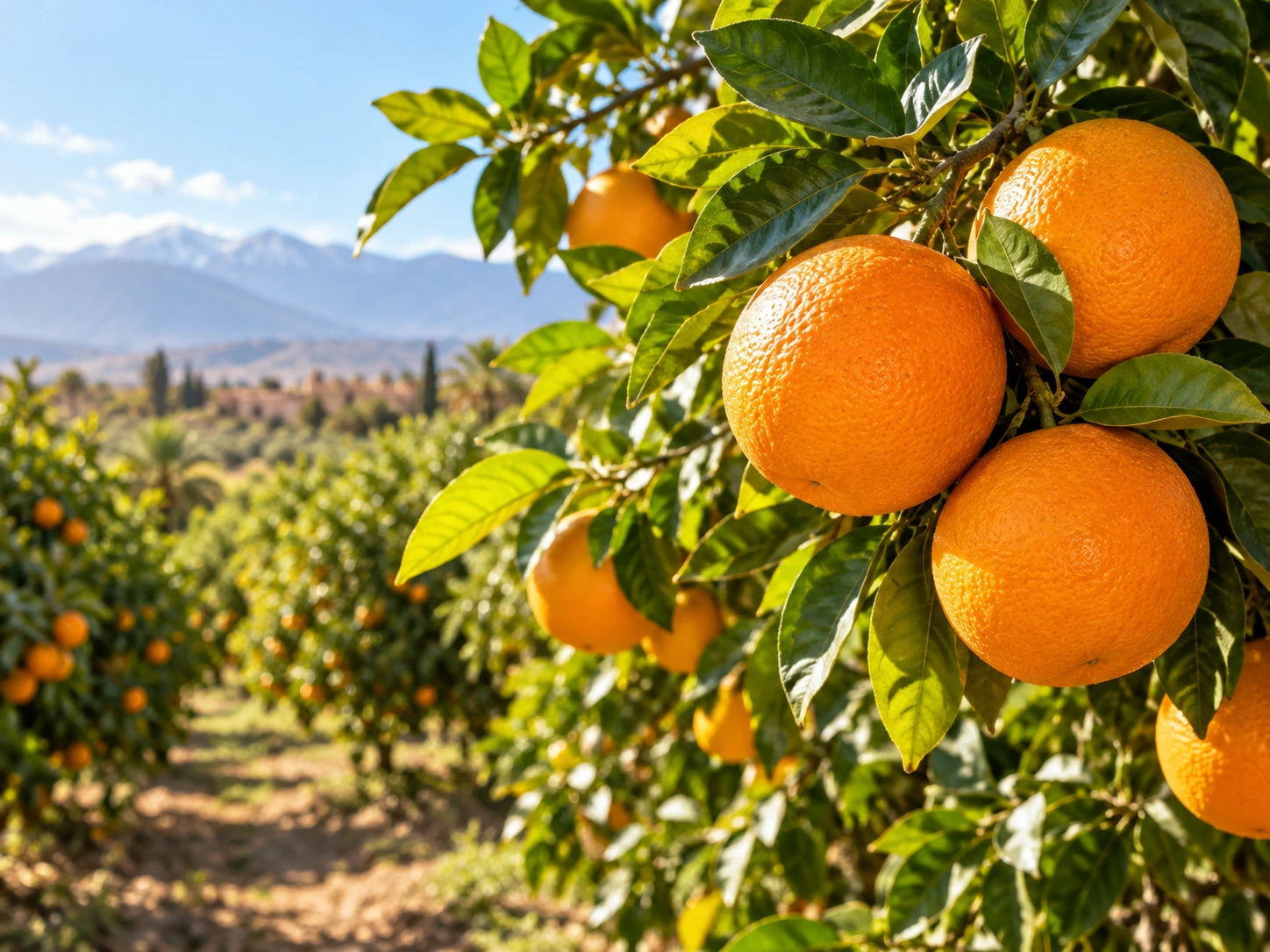
Navel oranges, Valencia-type oranges, clementines and Nadorcott mandarins are different commercial products. Variety, season, size and pack format matter. A quotation for one citrus type cannot be treated as a universal orange or mandarin price.
Avocados
Hass and green-skinned varieties may serve different customer programmes. Size, maturity, ripening expectations, condition and packaging can affect sourcing costs.
Berries and melons
For blueberries and raspberries, firmness, size, condition, retail packing and cold-chain needs may materially change the offer. Melons and watermelons may be priced differently depending on variety, maturity, fruit weight and transport economics.
3. Quality grade, calibre and maturity
Commercial grade and size requirements determine which fruit lots are suitable for the buyer. Narrow calibre ranges or strict cosmetic tolerances can affect the amount of produce that meets the specification.
| Quality factor | Why it matters |
|---|---|
| Commercial class | Different tolerances can change the proportion of acceptable fruit. |
| Calibre | Demand for a specific size range may restrict available lots. |
| Maturity | Harvest timing and suitability for transport or ripening affect sourcing. |
| External condition | Sorting and rejection rates can change packing costs. |
| Customer testing | Additional inspection or laboratory requirements may create costs. |
For EU-bound fruit, the European Commission explains applicable fruit and vegetable marketing standards. Buyers should confirm the relevant standard and any additional retailer specifications for the actual product.
Terms such as “premium” or “export quality” should be backed by measurable requirements and an agreed inspection procedure.
4. Wholesale quantity and order frequency
Order size affects sourcing and logistics. Some costs may be spread across a larger shipment, but more volume does not automatically guarantee a lower price per kilogram. If the requested grade or calibre is scarce, sourcing a larger matching quantity can be harder.
Specify total net kilograms, number of cartons or pallets, preferred shipment week and whether the enquiry is one-time or recurring. A recurring supply programme should explain its expected frequency and how later quantities and prices will be reconfirmed.
For example, 1,000 cartons containing 5 net kilograms each represent 5,000 net kilograms of fruit. This is a calculation example, not a standard export carton or minimum order.
5. Packaging, sorting and preparation
Bulk cartons, protective trays, retail punnets, labels and pallet configurations can have different material and labour costs. A quote for loose fruit cannot be compared directly with a quote for retail-ready packed fruit.
Confirm whether the proposed price includes sorting, grading, packing, primary containers, outer cartons, labels, pallets and any customer-specific artwork. Custom packaging may affect feasibility, lead time and cost.
See our fresh produce export packaging guide for a detailed buyer checklist.
6. Transport, route and delivery basis
International transport costs depend on the loading location, destination, route, shipment size, transport mode, handling and transit time. A price at a Moroccan handover point is not equivalent to a delivered price at a distribution centre abroad.
If an Incoterms® rule is used, agree on the rule and named place. Clarify which party is responsible for freight, insurance, loading, official controls, customs clearance and final delivery, as applicable.
Fresh fruit handling also varies by commodity. The requirements for citrus, avocados and berries are not identical. Discuss suitable packaging, cooling, loading condition and receiving inspection with the seller and logistics provider.
7. Export documents, food safety and inspections
The destination market and fruit category determine the relevant requirements. Depending on the transaction, the parties may need commercial invoices, packing lists, transport documents, origin evidence, phytosanitary certificates and other records.
Morocco’s ONSSA is an official reference for relevant export controls. EU buyers can investigate product-specific procedures through Access2Markets and pesticide maximum residue limits through the EU Pesticides Database.
Additional buyer-requested testing, audits or independent inspections may affect cost and lead time. Certification claims must be supported by valid evidence for the actual supplier, facility and scope; they should never be assumed.
8. Customs duties, origin rules and destination charges
Import duties and related charges can change the buyer’s landed cost. Trade arrangements between Morocco and the destination country may influence tariffs, but preferential treatment is not automatic for every fruit or shipment.
For EU imports, treatment may depend on the customs classification, seasonal measures, quotas, entry-price rules and valid origin evidence. The importer should confirm the current rules for the exact goods with official sources and a customs representative.
A Moroccan wholesale price should not be described as the final landed price unless the quotation explicitly covers all relevant costs and obligations.
9. Exchange rates, payment and quotation validity
Purchasing and selling may involve different currencies. Exchange-rate movements between the supplier’s purchasing currency and the buyer’s quoted currency can influence the commercial offer, especially when the enquiry and shipment are separated by time.
Payment terms, bank charges, credit arrangements and commercial risk may also affect pricing. Buyers should request a quotation validity period and confirm whether availability and price must be reconfirmed before each purchase.
10. Calculate the total cost of an imported fruit shipment
To compare offers fairly, start with the specified fruit and then identify every relevant additional cost. The exact allocation depends on the agreed delivery terms.
| Cost component | Question to ask |
|---|---|
| Fruit and grade | Which variety, quality and net weight are included? |
| Sorting and packing | Included in the product price or charged separately? |
| Cartons and pallets | Which materials and configurations are included? |
| Freight and handling | Which stages of the route are covered? |
| Documents and inspection | Which required services are included? |
| Insurance | Is coverage included and who arranges it? |
| Import duties and taxes | What is the current treatment for the exact goods? |
Illustrative calculation only: if a hypothetical fruit-and-packing quote is €1.20 per net kilogram and hypothetical additional freight and handling total €0.30 per net kilogram, the subtotal is €1.50 per net kilogram before other applicable costs. These figures are fictional examples, not current Moroccan wholesale fruit prices.
Wholesale price considerations by fruit category
| Fruit category | Key quotation details |
|---|---|
| Oranges | Variety, season, calibre, grade, carton and destination. |
| Avocados | Variety, count size, maturity, condition and packing. |
| Blueberries | Berry size, firmness, retail pack and transport plan. |
| Raspberries | Fruit condition, delicate handling and transit time. |
| Melons and watermelons | Variety, fruit weight, maturity and transport economics. |
How to request an accurate Moroccan fruit quotation
A useful request for quotation (RFQ) should contain:
- Fruit: product, variety and intended customer or use.
- Quality: grade, calibre, maturity and permitted defects.
- Quantity: total net kilograms, cartons and shipment frequency.
- Packaging: carton or retail pack, net weight, labels and pallets.
- Destination: importing country and receiving location.
- Timing: preferred loading or arrival period.
- Compliance: requested documents, inspections and certification evidence.
- Commercial terms: currency, delivery basis, payment terms and quotation validity.
When comparing offers, confirm that every seller is quoting the same specification and net weight. A low price for a different grade, calibre or delivery basis is not a like-for-like saving.
How MoroccanProduce.com prepares wholesale fruit prices
MoroccanProduce.com acts as the commercial seller to international buyers. We are not simply a supplier directory or an intermediary that introduces buyers to farms.
- Send your requirements. Share the fruit, variety, quality, quantity, packaging, destination and timing.
- We research Moroccan supply. We assess relevant suppliers, proposed lots, specifications and purchasing costs.
- We prepare a quotation. We describe the proposed goods and commercial conditions based on available information.
- We confirm the transaction. Once terms are agreed, we arrange the supplier purchase and resale to the buyer.
Availability, logistics, documents and requested certification evidence are checked for the actual enquiry. See our For Buyers page and supplier selection guide for more information.
Frequently asked questions about wholesale fruit prices in Morocco
How much does wholesale fruit cost in Morocco?
There is no universal price. A current quotation depends on the fruit, variety, grade, size, quantity, packaging and delivery basis.
Are Moroccan fruit prices lower during harvest season?
More supply may be available during the main season, but demand, weather, grade and logistics also affect pricing. A harvest window does not guarantee the lowest price.
Does a larger wholesale order always cost less per kilogram?
No. Some costs may be more efficient at larger volumes, but sourcing scarce grades or calibres in greater quantities may be difficult.
What is the difference between local wholesale and export prices?
Local references may exclude export sorting, packaging, documentation, international freight and other costs. An export quotation should identify what is included.
Are customs duties included in Moroccan fruit quotations?
Not necessarily. Duties and taxes depend on the destination, goods and agreed terms. Buyers should confirm responsibility for those charges before ordering.
Can I get a fixed Moroccan wholesale fruit price list?
MoroccanProduce.com prepares quotations for specific enquiries rather than promise a universal fixed price list. Send the product, specification, quantity, destination and preferred timing.
Request a wholesale Moroccan fruit quotation
Looking for a price on Moroccan oranges, avocados, berries, melons or another fresh-fruit category? Tell us the product, variety, grade, quantity, packaging, destination and target delivery period. We will research suitable supply options and prepare a quotation based on the available information.